
Astronomy and Space
Detailed Guides
Solar System Guide
Our Neighborhood in the Stars
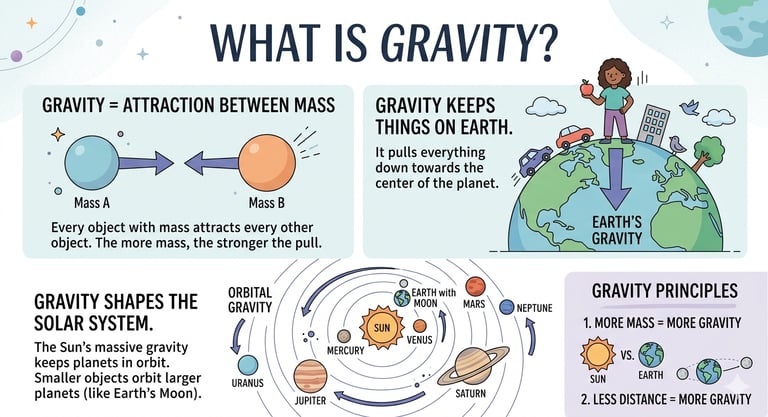
The Solar System is essentially a giant family, and like any family, it lives in a specific "house" located in a quiet corner of the Milky Way galaxy. Born about 4.6 billion years ago from a swirling cloud of stardust, our system is ruled by one member: the Sun. The Sun is so massive that it holds 99% of all the material in the entire system, using its gravity like an invisible leash to keep the planets from flying away into deep space.
The Inner "Rocky" Family
Closest to the Sun, we find the four terrestrial planets: Mercury, Venus, Earth, and Mars. These are "rocky" worlds, meaning you could actually stand on their surfaces.
Mercury is the smallest and fastest. Because it has almost no air to trap heat, it’s a land of extremes—freezing at night and baking hot during the day.
Venus is often called Earth’s twin because they are the same size, but it is a "deadly twin." It has a thick, choking atmosphere of carbon dioxide that acts like a heavy blanket, trapping heat and making it the hottest planet in the system—hot enough to melt lead!
Earth is our perfect "Goldilocks" home—not too hot, not too cold, but just right for liquid water and life.
Mars is the "Red Planet." It’s a cold, dusty desert today, but billions of years ago, it likely had blue skies and rushing rivers.
The Outer "Giant" Family
Beyond the asteroid belt, the planets change completely. These are the Gas and Ice Giants. They don’t have a solid surface; if you tried to land a ship on Jupiter, you would simply sink deeper and deeper into its thick clouds until the pressure crushed you.
Jupiter is the "King of the Planets," so big that 1,300 Earths could fit inside it. It’s famous for the Great Red Spot, a storm that has been spinning for centuries.
Saturn is the "Jewel of the Solar System" because of its spectacular rings. These rings aren't solid disks; they are made of billions of chunks of ice and rock, some as small as a grain of sand and others as big as a house.
Uranus and Neptune are the "Ice Giants." They are freezing cold and deep blue. Uranus is unique because it spins on its side, rolling like a bowling ball as it orbits the Sun.
"Did You Know?"
The Sun is a Monster: You could fit 1.3 million Earths inside the Sun. If the Sun were the size of a typical front door, Earth would be the size of a tiny nickel!
A Year of Days: On Venus, a "day" is longer than a "year." It takes longer for Venus to rotate once on its axis than it does to travel all the way around the Sun.
Space is Silent: Because there is no air in space to carry sound waves, you couldn't hear a massive explosion right next to you. It’s completely silent!
Planetary Data Table:
Note: Orbital speed for the Sun is its speed around the Galactic Centre. In astronomy, "Rotation Speed" can refer to two different types of motion: how fast a planet spins on its own axis (Self-Rotation) and how fast it travels along its orbit around the Sun (Orbital Speed).
Key Insights into These Stats
The Tilted Traveler: Mercury has the most extreme Orbital Inclination (7°). This means its path is quite "tilted" compared to Earth's, which is why we don't see Mercury pass directly in front of the Sun (a transit) very often.
Distance is Constant Change: Because all planets move at different speeds, the "Distance from Earth" is always changing. The values above are the average distances. Venus is our closest planetary neighbour, while Neptune is our most distant.
The Baseline: Earth's inclination is 0° because we use Earth's own orbital plane (called the Ecliptic) as the universal "flat" reference point for the rest of the solar system.
Fastest Spinner: Jupiter has the highest self-rotation speed, completing a "day" in less than 10 hours despite its massive size.
Fastest Traveler: Mercury has the highest orbital speed because it is closest to the Sun's powerful gravity.
Slowest Spinner: Venus rotates so slowly that its "day" is actually longer than its "year."
The Outer Frontier: Kuiper Belt and Oort Cloud
1. The Kuiper Belt: The Third Zone
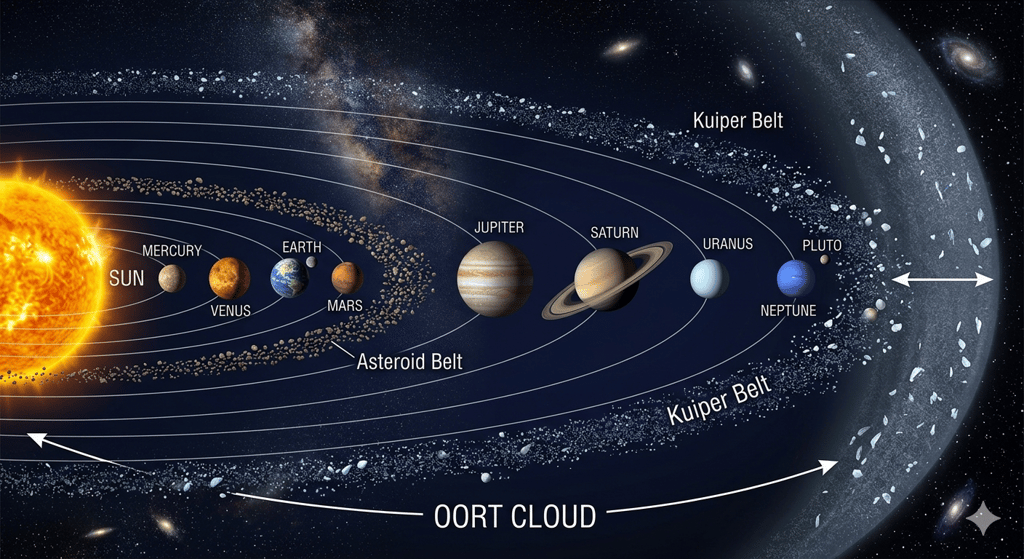
The Kuiper Belt is an enormous, donut-shaped region of icy objects that begins just beyond the orbit of Neptune. It is often called the "third zone" of the solar system, following the rocky inner planets and the outer gas giants.
Location: It extends from Neptune's orbit at 30 AU to approximately 50 AU from the Sun.(AU-Astronomical Unit-unit of length representing the average distance between the Earth and the Sun= 150 million km approx.)
Composition: Unlike the rocky Asteroid Belt, objects here are mostly "ices"—frozen water, ammonia, and methane.
Famous Residents: It is home to several dwarf planets, including Pluto, Haumea, Makemake and Eris.
Origin of Comets: The Kuiper Belt is the primary source of short-period comets, which take less than 200 years to orbit the Sun (like Halley’s Comet).
2. Comets and Asteroids: Celestial Travelers
Asteroids: Mostly rocky and metallic bodies found primarily in the Asteroid Belt between Mars and Jupiter. They are essentially leftovers from the formation of the inner planets.
Comets: Often described as "dirty snowballs," comets are made of ice, dust, and rock.
The Tail: As a comet nears the Sun, its ices turn into gas (sublimation), creating a glowing "coma" and two tails—a straight blue ion tail and a curved white dust tail.
The Direction: A comet's tail always points away from the Sun, pushed by solar wind, regardless of which way the comet is traveling.
3. The Oort Cloud: The Solar System’s Edge
The Oort Cloud is a theoretical spherical shell that surrounds the entire solar system like a thick bubble. It marks the absolute limit of the Sun's gravitational influence.
Location: It is staggeringly far away, starting between 2,000 and 5,000 AU and extending as far as 100,000 AU—nearly halfway to the next star.
Shape: While the rest of the solar system is flat like a pancake, the Oort Cloud is a giant sphere.
The Long Fall: This region is the source of long-period comets, which can take thousands or even millions of years to complete one trip around the Sun.
Formation: Scientists believe these icy chunks formed closer to the Sun but were sling-shotted out to the edges by the massive gravity of Jupiter and Saturn billions of years ago.

Gravity
The surface gravity of an object in the solar system is determined by its mass and radius. While massive planets like Jupiter have strong gravity, their large size means you are further from the center, which slightly offsets the pull.
The following table compares the surface gravity of major solar system bodies to Earth's gravity ( 1g is approx.. 9.81 m/s^2)
Note: In physics, kg is a measure of mass, which stays the same everywhere. This table shows your "effective weight" (the force you would feel) expressed in equivalent kilograms on Earth for simplicity.
Key Observations
The Extremes: The Sun has the most intense gravity, nearly 28 times that of Earth. Conversely, Pluto’s gravity is so weak that you would weigh only about 6% of your Earth weight.
Gas Giant "Surfaces": Because gas giants like Jupiter and Saturn lack a solid surface, their gravity is measured at the cloud tops where the pressure equals 1 bar (Earth's sea-level pressure).
Mars vs. Mercury: Despite being much larger, Mars has almost the same surface gravity as Mercury because Mercury is significantly denser.
Earth's "Twin": Venus is the closest to Earth in terms of gravity, at roughly 90%.
The Solar System’s Place in the Milky Way
Our entire planetary system is in motion within a massive barred spiral galaxy.
Position: Located on the inner edge of the Orion Arm (or Orion Spur), situated between the larger Sagittarius and Perseus spiral arms.
Distance from Galactic Center: Approximately 26,000 to 28,000 light-years away from the center of the Milky Way.
Galactic Rotation Speed: The solar system orbits the galactic center at about 828,000 km/h (515,000 mph).
The Galactic Year: It takes about 230 million years for the solar system to complete one full orbit around the galaxy.
Quick Comparison: Kuiper vs. Oort
“There is always more to discover and learn within and outside, each planet itself is a vast topic for discovery and research and of course our Sun as well.”
Interactive Mechanics
Make your learning experience more alive by using the following interactive mechanics guide of the solar system. Our solar system is a beautiful example of celestial mechanics. The elliptical orbits, the motions, the gravity, the compositions all well designed in their places so that we enjoy this fantastically curious life on our home planet earth.
Meteor Shower Guide
Catching the Cosmic Fireworks
Have you ever looked up at night and seen a "shooting star"? It’s a magical sight, but it isn’t actually a star at all. It is a tiny piece of space dust, often no bigger than a grain of sand, burning up as it hits Earth's atmosphere. A Meteor Shower happens when Earth travels through a "cluttered" part of space, hitting hundreds of these dust particles at once.
Where does the dust come from?
Think of a comet as a giant, dirty snowball traveling through space. As it gets close to the Sun, it starts to melt and crumble, leaving a trail of crumbs behind it. These crumbs stay in space for thousands of years. Every year, at the same time, Earth's orbit takes us right through these "crumb trails." This is why meteor showers, like the Perseids in August, happen on the same dates every year.
How to Watch Like a Pro
To see the best show, you need two things: darkness and patience.
Escape the City: City lights act like a veil, hiding the fainter meteors. Find a dark spot in a park or countryside.
The "Radiant" Trick: Every shower has a "Radiant"—a specific spot in the sky where the meteors seem to emerge from. For example, in the Leonids shower, the meteors look like they are coming from the constellation Leo. However, don't just stare at that one spot! Meteors can appear anywhere in the sky.
Wait for Midnight: The best viewing is usually after midnight. This is because, as Earth spins, your location moves to the "front" of the planet, which is the part hitting the dust trail first—kind of like how more bugs hit the front windshield of a moving car than the back window.
Write your text here...
Meteor Shower Calendar (India Standard Time)
*ZHR (Zenithal Hourly Rate) is the number of meteors visible per hour under a perfectly dark, clear sky.
Meteor Shower Guide: "Fast Facts"
Faster than a Bullet: Meteors enter our atmosphere at speeds up to 72 kilometers per second. That’s about 100 times faster than a jet plane!
Space Dust in Your Hair: Every day, about 100 tons of space dust falls onto Earth. It's so fine that you’re likely breathing in tiny bits of the cosmos every day.
Not a Star: A "shooting star" is usually the size of a grain of sand. The bright light you see is the air around it glowing, not the rock itself.
Use the following Meteor Shower Interactive Demo to further understand them.(constellation diagrams limited and approximate, may lack accuracy.)
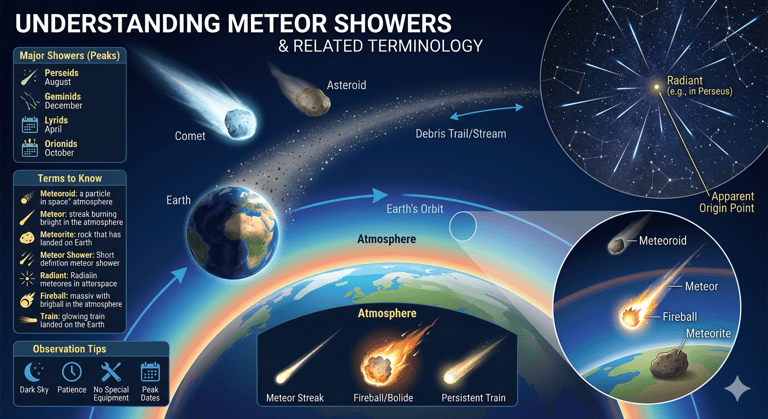
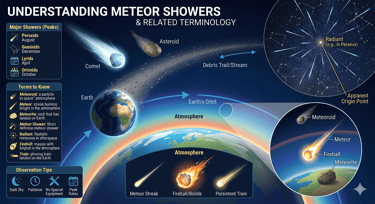
Next time you watch a shooting star, don't forget it is not a star like in popular terms, it is space throwing junk at us! Thanks to planet earth, it burns it and doesn't let it fall down on us!!
Night Sky Guide
Navigating the Dark Beyond
The night sky can look like a confusing mess of dots, but with a little practice, it becomes a familiar map. To start your journey as a "Skywatcher," you first need to learn how to tell the difference between a star and a planet.
The Twinkle Test
Stars are giant suns very far away. Because they are so distant, they appear as tiny "points" of light. As their light travels through our shaky, windy atmosphere, it gets knocked around, making them "twinkle." Planets, on the other hand, are much closer. They appear as tiny "disks" rather than dots. This makes their light steadier and stronger, so planets usually do not twinkle. If you see a bright light that is shining steadily, it’s likely Jupiter, Mars, or Venus!
The Moon: Your Best Friend
The Moon is the easiest thing to observe. Most people think a Full Moon is the best time to look, but that’s a common mistake! During a Full Moon, the sun is shining directly on the face of the Moon, making it look flat and bright. The best time to look is during a Crescent or Quarter Moon. Look at the "Terminator"—the line where the light meets the dark. This is where the shadows are longest, making the craters and mountains look like 3D textures. You can see incredible detail here even with a cheap pair of binoculars.
Using "Star Hopping"
To find something hard to see, use something easy to find. This is called "Star Hopping." For example, if you find the "Big Dipper" (which looks like a giant ladle), you can follow the two stars at the end of the bowl to find the North Star. Once you find one landmark, you can "hop" from star to star to find galaxies and nebulae.
Night sky watching is a journey of both simple wonder and rigorous precision. Here is a comprehensive guide presented from both perspectives.
For the Layman: The Joy of Looking Up
Stargazing is as easy as finding a dark spot away from city lights, lying on a blanket, and letting your eyes adjust to the darkness for about 20 to 30 minutes. You don't need fancy equipment to start—your eyes are perfect for seeing bright planets, the Moon, and major constellations like Orion or the Big Dipper. A simple trick to tell things apart is that stars twinkle because their light is "bounced" by our air, while planets usually shine with a steady, unmoving light. If you want a closer look, a standard pair of 10x50 binoculars is often better for beginners than a telescope because they are easier to point and show more of the sky at once. Using a red-tinted flashlight or a night sky map can help you find objects without ruining your "night vision".
For the Technical Observer: Precision & Equipment
Serious observation requires managing atmospheric seeing and transparency to maximize the resolving power of your optics. Observers use the Bortle Scale (Class 1 for pristine dark to Class 9 for inner-city) to quantify light pollution and determine what Deep Sky Objects (DSOs) like nebulae or galaxies are within reach.
Optics: While refractor telescopes use lenses to focus light for high-contrast planetary views, reflector telescopes (Newtonians) utilize mirrors to achieve larger apertures—the critical diameter of the main lens or mirror—allowing for greater light-gathering and the resolution of fainter objects.
Navigation: Advanced users rely on celestial coordinates (Right Ascension and Declination) and techniques like "star-hopping"—moving from a known bright star to a target using a star chart.
Enhancements: To combat city glow, light pollution filters can block specific mercury and sodium emission lines. For those moving into astrophotography, a stable equatorial mount is essential to track the Earth’s rotation and enable long-exposure captures.
Now let us progress from a beginner to a more advanced observer.
1. What is Limiting Magnitude?
Limiting Magnitude is the brightness of the faintest star or celestial object that can be seen by an observer.
Naked Eye: Under a perfectly dark, clear sky, the average human eye can see stars down to about Magnitude 6.5.
City vs. Dark Sky: In a brightly lit city, this might drop to Magnitude 1 or 2 (only the brightest stars), while remote areas can reach Magnitude 7 or higher.
Instruments: Binoculars can push your limit to Magnitude 9.5, and amateur telescopes can reveal objects as faint as Magnitude 15 or more.
2. Essential Instruments for Stargazing
Naked Eyes: Best for learning constellations and spotting meteor showers.
Binoculars (e.g., 7x50 or 10x50): The "beginner's best friend" because they provide a wide field of view and are easy to use.
Telescopes:
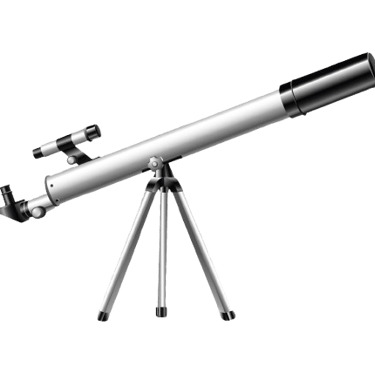
Refractors: Use lenses; great for high-contrast views of the Moon and planets.
Reflectors (Dobsonians): Use mirrors; popular for seeing faint "Deep Sky" objects like galaxies and nebulae.
Smart Telescopes: Modern "all-in-one" devices that automatically find and track objects using a smartphone.
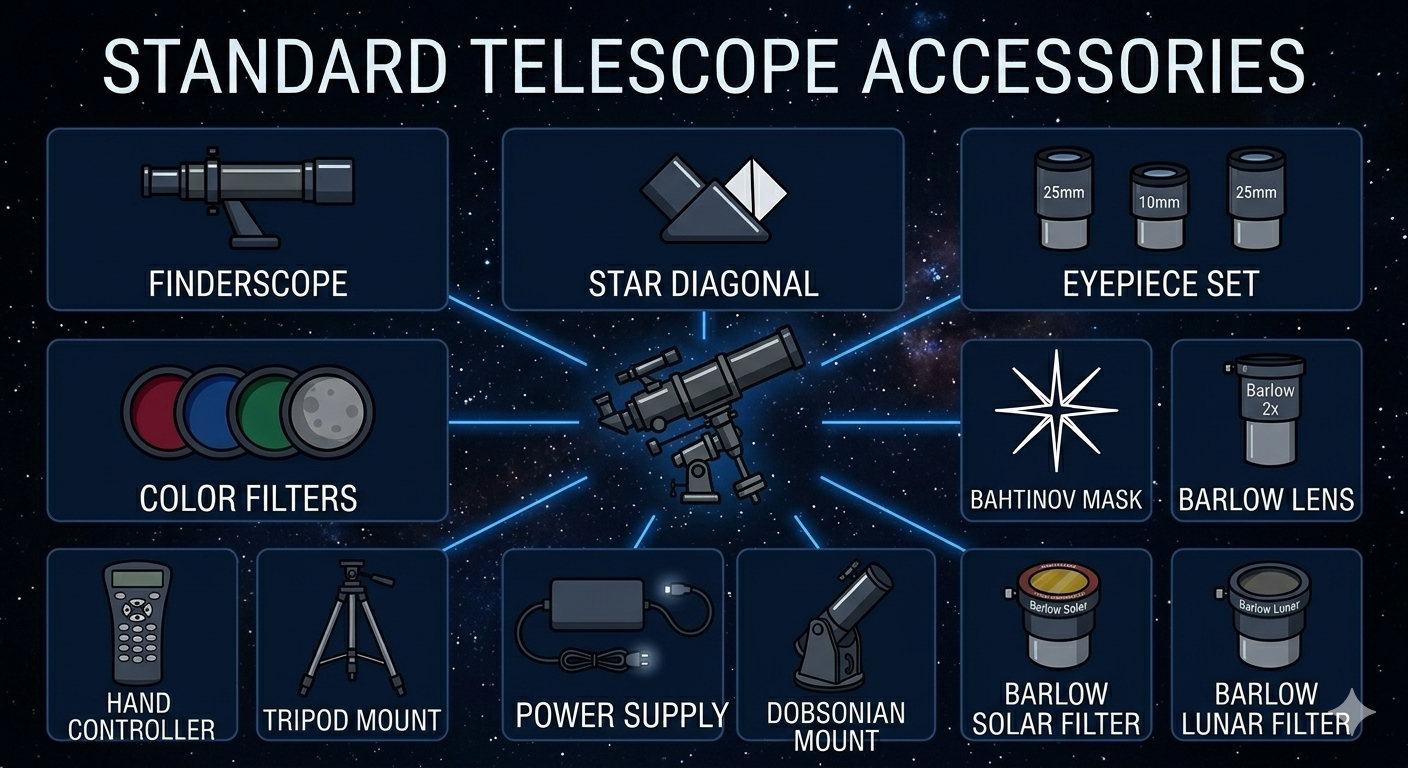
Accessories: A red-light flashlight (to preserve night vision), a planisphere (star wheel), and a sturdy tripod.
3. Standard Night Sky Objects
Solar System: The Moon (craters and mountains), Jupiter (its bands and 4 largest moons), and Saturn (its rings).
Deep Sky Objects (DSOs):
Star Clusters: The Pleiades (Seven Sisters) or the Beehive Cluster.
Nebulae: The Orion Nebula (a massive stellar nursery).
Galaxies: The Andromeda Galaxy (the furthest object visible to the naked eye).
Human-Made: The International Space Station (ISS) and other satellites.
4. How to Choose a Location
The quality of your view depends almost entirely on your location:
Darkness: Use the Bortle Scale or a Light Pollution Map to find "Class 1" or "Class 2" skies.
Elevation: Higher altitudes have "thinner" air and less dust, leading to clearer views.
Obstructions: Look for a place with a clear, 360-degree view of the horizon.
India Favorites: Sites like Hanle in Ladakh (India's first Dark Sky Reserve), Spiti Valley, or remote parts of the Thar Desert are world-class.
5. Can One Photograph the Night Sky?
Yes, and it’s easier than ever. Astrophotography ranges from simple phone shots to advanced setups.
Smartphone: Many modern phones have a "Night Mode" that can capture the Milky Way if held steady on a tripod.
DSLR/Mirrorless: Use a "fast" wide-angle lens (f/2.8 or lower) on a tripod.
The 500 Rule: To avoid "star trails" (where stars look like lines instead of dots), divide 500 by your lens's focal length to get your maximum exposure time in seconds (e.g., 500 / 20mm = 25 seconds).
Key Concepts to Remember
Dark Adaptation: It takes your eyes 20-30 minutes to fully adjust to the dark. One glance at a bright phone screen can reset this.
Atmospheric Seeing: This refers to the stability of the air. If the stars are twinkling violently, the "seeing" is poor, and high-magnification views will be blurry.
Advancing in night sky watching requires a blend of practical habits and specific navigational skills. Below are the essential tips and skills to master.
Core Skills to Develop
Star-Hopping: This is the most fundamental skill for finding objects that aren't visible to the naked eye. It involves using bright, recognizable stars (like the "Pointer" stars in the Big Dipper) to "hop" your way to fainter targets.
Estimating Angular Distance: Astronomers use degrees to measure the sky. A useful trick is using your hand at arm's length:
1 degree: Your pinky finger width.
10 degrees: A clenched fist.
25 degrees: An outstretched hand (thumb to pinky).
Averted Vision: This technique involves looking slightly to the side of a faint object rather than directly at it. Your peripheral vision is more light-sensitive, allowing you to see dimmer details in nebulae or galaxies.
Celestial Navigation: Understanding how objects move—rising in the East and setting in the West—helps you predict where a planet or constellation will be hours later.
Essential Stargazing Tips
Preserve Your Night Vision: Use a red-light flashlight or set your stargazing app to "Night Mode". White light from a phone or streetlamp instantly resets your dark adaptation, which takes 20–30 minutes to build back up.
Check the Moon Phase: The best time for deep-sky watching is during a New Moon. A Full Moon acts like natural light pollution, washing out everything except the brightest stars and planets.
Acclimatize Your Equipment: If you are using a telescope, set it outside about an hour before viewing. This allows the mirrors or lenses to reach the same temperature as the outside air, preventing blurry views caused by internal heat currents.
Dress Warmer Than You Think: Even in summer, standing still for hours can make you cold. Layers, thick socks, and a warm hat are standard gear for any serious session.
Keep an Observing Log: Recording what you see (even a simple sketch or note) helps train your brain to notice finer details over time.
Useful Tools & Gear
Planisphere: A simple, rotating star wheel that shows you exactly what's in the sky at any time of year without needing batteries.
Red Light Torch: Essential for reading star charts without ruining your night vision.
Reclining Chair: Vital for long sessions to avoid neck strain while looking straight up.
A standard night sky map looks like this:
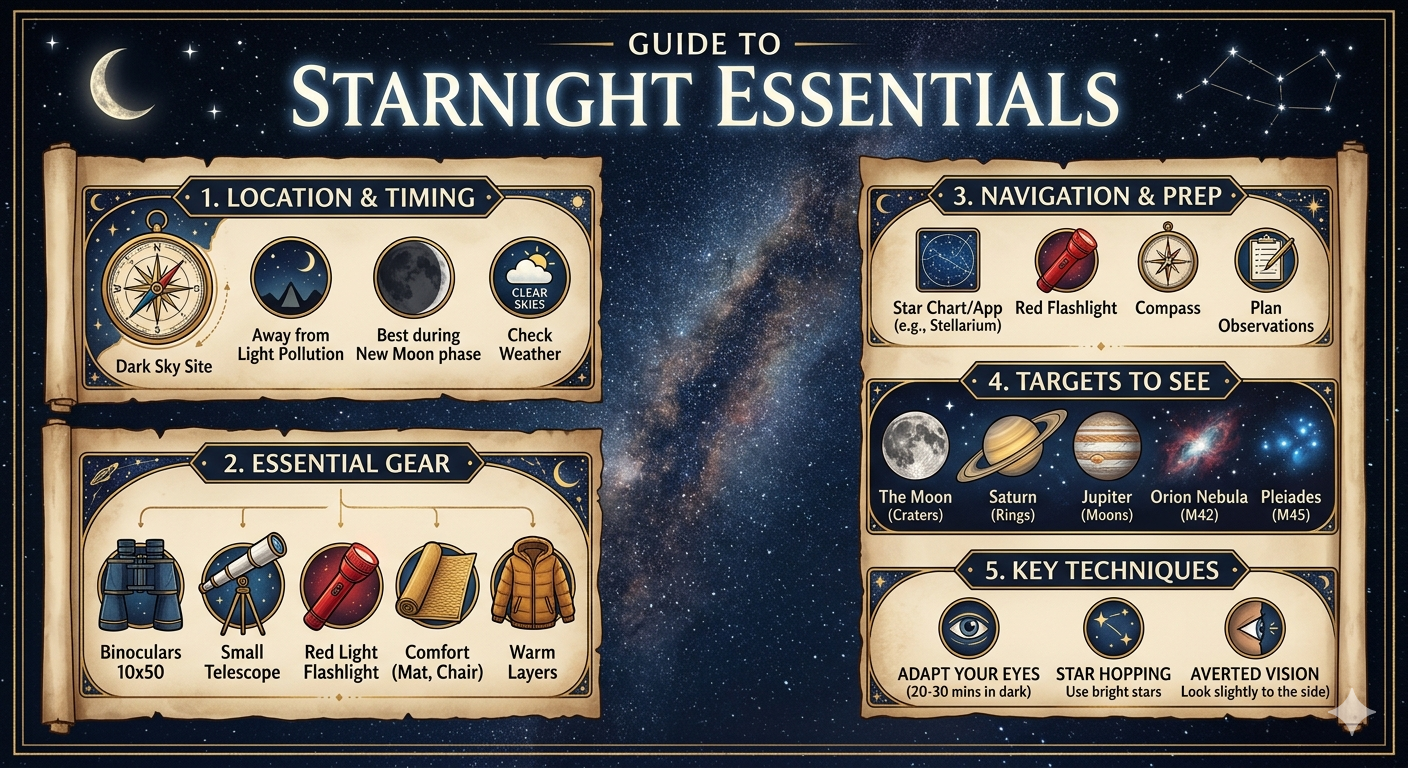
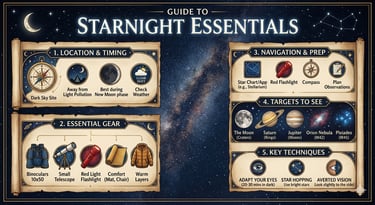
Summery:
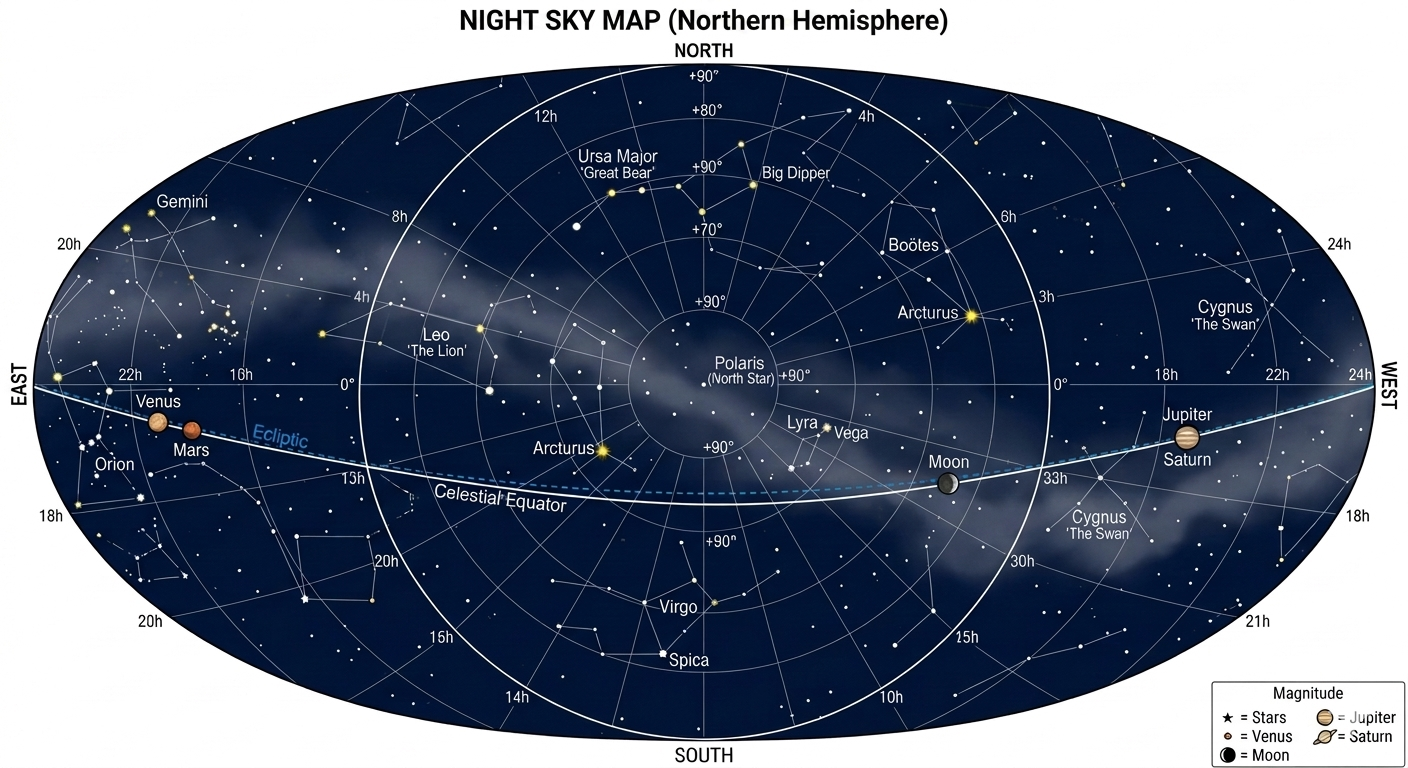
Next time when you look at the night sky, to see the light from the farther, you may need to switch off some lights nearer to you.
Satellite Guide
Our Eyes in the High Heavens
A satellite is simply anything that circles a planet. The Moon is a "natural" satellite, but today, we have thousands of "artificial" satellites—machines we built and launched into space to help us live our lives on Earth.
How do they stay up there?
This is the most common question. People think satellites are floating, but they are actually falling. Imagine throwing a ball very hard. It travels a bit and then falls to the ground. Now imagine throwing it so fast (17,500 mph!) that as it falls, the Earth’s surface curves away beneath it. The satellite is essentially falling around the curve of the Earth forever. This state of constant falling is called an "orbit."
The Anatomy of a Satellite
Even though they look like high-tech spiders, most satellites have the same basic parts:
The Bus: This is the main body that holds the computers.
Solar Panels: These look like big wings and capture sunlight to keep the batteries charged.
Antennas: These send and receive signals. Your GPS, your TV, and even your weather forecast all depend on these antennas talking to us from space.
Two Main Types of Orbits
Low Earth Orbit (LEO): These satellites are close to Earth (about the distance from Delhi to Mumbai). They move very fast, circling the whole world in just 90 minutes. This is where the International Space Station and imaging satellites live.
Geostationary Orbit (GEO): These are much higher up. They move at the exact same speed that Earth spins. This makes them look like they are standing still over one spot on the map, which is perfect for satellite TV.
Can You See Them?
Yes! If you look up shortly after sunset or before sunrise, you can see satellites moving across the sky. Unlike airplanes, they don't have blinking lights; they look like steady, moving stars. The brightest one you can see is the International Space Station (ISS), which often looks brighter than any star in the sky!
Fun Fact for Kids: If you were on a satellite in LEO, you would see 16 sunrises and 16 sunsets every single day because you are moving so fast!
Artificial satellites have transformed from experimental metal spheres into complex global infrastructures. As of early 2026, over 12,950 satellites orbit Earth, a number that has grown more in the last four years than in the previous seven decades.
Satellite Statistics by Country (Approx. as of 2026)
The "orbital race" is currently led by a few major space powers, with private commercial constellations significantly inflating the numbers.
Historical Milestones: The "Firsts" in Orbit
The history of satellites is a timeline of rapid technological leaps, starting from the 50's-60's space race.
Space Telescope Satellites: Our Cosmic Observatories
Space telescopes operate above Earth's atmosphere to capture clear images across the electromagnetic spectrum.
Common Satellite Uses by Orbit
The distance from Earth determines what a satellite does.
Low Earth Orbit (LEO): 160–2,000 km. Fast-moving. Used for high-res imaging (Landsat), the ISS, and satellite internet (Starlink).
Medium Earth Orbit (MEO): ~20,000 km. Used for navigation like GPS (USA), GLONASS (Russia), and Galileo (EU).
Geostationary Orbit (GEO): ~36,000 km. Stays fixed over one spot. Used for TV broadcasts and continuous weather monitoring.
The Evolution of Space Stations: Past, Present, and Future
The journey of space stations reflects humanity's transition from short-term orbital visits to permanent habitation in the stars. This guide traces the evolution of these "homes in the sky," from the first experimental modules to the massive international laboratories and future commercial outposts orbiting the Moon.
Key Technical Distinctions
Monolithic (Historical): Built as a single unit and launched all at once. Once the supplies ran out, the station was abandoned.
Modular (Current & Future): Built like "Lego blocks" in space. Modules are launched separately and docked together, allowing the station to grow and be repaired over decades.
Commercial (Future): The shift from government-funded exploration to private-sector "rentable" space labs for medicine, manufacturing, and tourism.
Satellite technology has also paved way for deep space expeditions, leaving our home. But we are really the residents of this planet? Who knows?
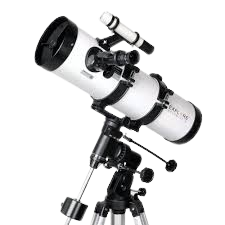
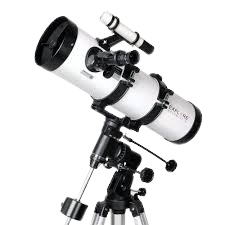
The "Dobsonian" Choice: If you want the biggest "bucket" for the lowest price, look for a Dobsonian Reflector. It is a large mirror on a simple, sturdy wooden base—perfect for school projects and backyard discovery.
"When choosing your first telescope, focus on the technical specifications rather than brand names. For those interested in the Moon and bright planets, a 90mm Refractor offers sharp, maintenance-free views. If your goal is to see faint galaxies and star clusters, a 6-inch or 8-inch Dobsonian Reflector provides the best 'light-gathering' value for your investment."
Final Tip for Your Guide
"A smaller, high-quality telescope that is easy to set up will be used far more often than a massive, complicated one. Your best telescope is the one you actually use."
Telescope Guide
Choosing Your Window to the Stars
Many people think a telescope is like a giant "zoom lens" for your eyes. While it does magnify things, its real job is much more important: it is a "Light Bucket."
Observatory Guide
The Cathedrals of Science
An observatory is a special place built for one reason: to get the clearest possible view of the universe. While you can stargaze from your balcony, professional astronomers need to get away from "the soup" of Earth's atmosphere.
The Obstructions: Thick Air and Artificial Night Light
Our atmosphere is like a thick, blurry blanket. It’s full of dust, water vapor, and heat waves that make the stars look fuzzy. To beat this, we build observatories in three specific places:
High Mountains: By building on a peak (like in the Himalayas or Hawaii), we get above the thickest, dirtiest part of the air.
Deserts: We need dry air. Humidity and clouds are the enemies of a good star-viewing session.
Space: The ultimate observatory is a satellite (like the Hubble or James Webb). By leaving Earth entirely, astronomers can see the universe in perfect, crystal-clear detail.
Domes and Dishes
Most observatories have a "Dome" with a slit that opens to the sky. Inside is a massive optical telescope. However, some observatories look like giant satellite dishes. These are Radio Observatories. They don't look at "light"; they listen to "radio waves" coming from space. The cool thing about radio waves is that they can travel through thick clouds of space dust that block regular light, allowing us to see things that are otherwise hidden.
For the Layman: Why We Build Them
Think of the Earth's atmosphere like a thick, wavy pool of water. Looking at stars through it is like trying to read a book at the bottom of that pool—everything looks blurry and distorted. Observatories are built on mountain peaks (to get above as much air as possible) or launched into space (to remove the air entirely) to get a "HD" view of the cosmos.
The Technical Anatomy of an Observatory
A modern observatory is an integrated system of several high-tech components:
The Dome: A protective shell with a "shutter" or "slit" that opens to the sky. Domes are designed to rotate so the telescope can point in any direction.
The Pier: A massive concrete pillar that goes deep into the ground. The telescope sits on this, not the floor, to ensure that footsteps or wind don't cause even the slightest vibration.
Active & Adaptive Optics: Systems of small motors that literally "flex" the telescope's mirror hundreds of times per second to cancel out atmospheric twinkling in real-time.
Spectrographs: Instruments that split light into a rainbow (spectrum). This allows scientists to determine what a star is made of, its temperature, and how fast it’s moving.
Observatory Types by Wavelength
Not all observatories look at "visible" light. Different wavelengths tell different stories about the universe:
Radio Observatories: Use giant "dishes" to listen to the faint whispers of gas clouds and pulsars. They can even "see" through clouds and rain.
Solar Observatories: Specifically designed to look only at our Sun without melting their own mirrors.
High-Energy (X-Ray/Gamma): These must be in space because the Earth’s atmosphere blocks these dangerous rays (luckily for us!).
List of Famous Global Observatories
Professional observatories are often grouped into "complexes" at the best viewing sites in the world.
The Cosmic Ears: How Radio Telescopes "Listen" to the Universe
Radio telescopes are sophisticated antennas that capture invisible, long-wavelength radiation rather than visible light, allowing us to "see" through cosmic dust clouds that block standard telescopes. Technically, they act as massive collectors that reflect radio waves onto a receiver, where weak signals from pulsars and distant galaxies are amplified and converted into digital images and data for scientific analysis.
LIGO: The Engineering of Spacetime Precision
LIGO (Laser Interferometer Gravitational-Wave Observatory) is a sophisticated precision-measurement system based on advanced laser interferometry, where dual 4km-long vacuum arms are monitored to a tolerance of less than one-thousandth the width of a proton. To a layman, it is a facility designed to "hear" the universe, but technically, it is a high-performance L-shaped detector that senses the minute stretching and squeezing of spacetime caused by cataclysmic cosmic events like black hole mergers. This global network allows for the pioneering field of multi-messenger astronomy through unprecedented sensitivity and standardized data synchronization.
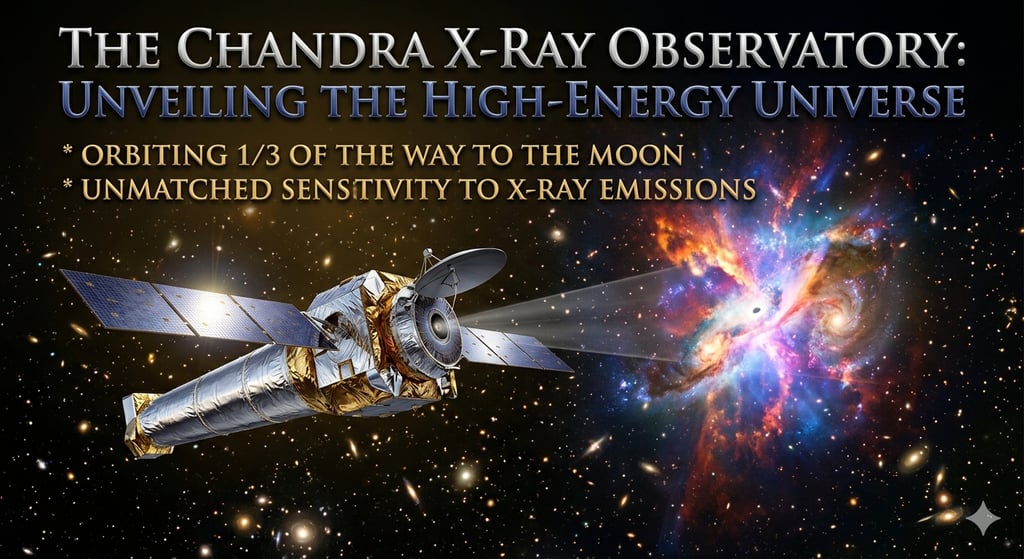
Chandra X-ray Observatory: The Universe's High-Energy Eye
The Chandra X-ray Observatory is a flagship NASA telescope designed to detect X-ray emissions from the hottest and most turbulent regions of the universe, such as exploded stars and clusters of galaxies. Technically, it utilizes highly polished, nested cylindrical mirrors to focus high-energy photons that would otherwise pass through ordinary glass, revealing "invisible" cosmic phenomena that are millions of degrees hot.
What’s Special About It?
Extreme Sensitivity: Chandra can resolve X-ray sources 100 times fainter than any previous X-ray telescope, allowing it to "see" the particles just before they disappear into a black hole.
Orbiting High: Unlike the Hubble Space Telescope, Chandra orbits Earth in a very long oval that takes it one-third of the way to the Moon, giving it a clear view of the deep sky for long periods without the Earth getting in the way.
X-Ray Vision: It provides the data needed to understand the "High-Energy Universe," effectively acting as a cosmic X-ray machine for the stars.
Solar Observatory
A Solar Observatory is a specialized scientific facility—either on the ground or in space—designed specifically to study the Sun. Unlike standard observatories that work at night, solar observatories operate during the day to monitor solar activity like sunspots, flares, and magnetic storms that can affect life on Earth.
For the Layman: Why Watch the Sun?
The Sun is our closest star and the engine of our solar system. A solar observatory uses special "sunglasses" (filters) to look at the Sun without being blinded. By watching solar flares and "space weather," scientists can predict and protect our power grids and communication satellites from harmful solar radiation.
For the Technical Mind: Precision Solar Physics
Technically, solar telescopes utilize high-focal-length optics and frequently operate in a vacuum or helium-filled path to eliminate internal air turbulence (convection) caused by the Sun's intense heat. They use instruments like spectroheliographs and magnetographs to map the Sun's magnetic fields and chemical composition across various wavelengths, including H-alpha, Calcium K and Infrared.
Upcoming Solar Missions (2026–2035)
Solaris (2025/2026): A mission specifically designed to provide the first oblique-angle views of the Sun's poles.
National Large Solar Telescope (NLST): A planned 2-meter class Indian facility in Ladakh for high-resolution solar magnetic field studies.
European Solar Telescope (EST): A future flagship 4-meter telescope to be built in the Canary Islands.
What these observatories prove that the human endeavor and curiosity can extend far beyond what it can imagine!
A short Rocketry Guide
How We Reach the Stars
Rocketry is the science of "Action and Reaction." If you've ever blown up a balloon and let it go without tying it, you’ve seen a rocket in action. The air rushes out the back (the action), and the balloon flies forward (the reaction).
Newton’s Third Law
Space is a vacuum, which means there is no air to "push" against. A common myth is that rockets push against the air or the ground. They don't! A rocket moves forward because it is throwing heavy gas out of its engine at incredible speeds. This "push" is called Thrust. To get into space, a rocket has to produce enough thrust to overcome its own Weight (the pull of gravity).
The Stability Secret
If you want to build a simple bottle rocket or a model rocket, you need to know about two points: the CG and the CP.
Center of Gravity (CG): This is the balance point. If you held the rocket on your finger, where would it stay level? That’s your CG.
Center of Pressure (CP): This is where the wind pushes on the rocket.
The Rule: For a rocket to fly straight like an arrow, the weight (CG) must be in the front, and the fins (CP) must be in the back. If the weight is in the back, the rocket will flip and spin out of control the moment it leaves the launchpad.
Planetary Guide
The Many Faces of Other Worlds
Every planet in our solar system is a unique world with its own "personality." Planetary science is the study of why these worlds look so different even though they were all made from the same stuff.
Extreme Environments
The Pressure Cooker (Venus): Venus is a nightmare world. Its air is so heavy it would crush a human like an empty soda can. It rains sulfuric acid and has volcanoes that cover almost the entire surface.
The Giant Storm (Jupiter): Jupiter is a ball of gas with no solid ground. Its "Great Red Spot" is a hurricane so big that two Earths could fit inside it, and it has been spinning for at least 300 years.
The Frozen Desert (Mars): Mars has the largest volcano in the solar system (Olympus Mons) and a canyon so long it would stretch across the entire country of India.
The Search for Water and Life
One of the biggest goals of planetary science is finding water. We know Mars once had oceans, and we suspect that some moons of Jupiter and Saturn (like Europa and Enceladus) have massive liquid oceans hidden under a thick crust of ice. These are the places we are most likely to find alien life, like tiny microbes, swimming in the dark.
Exoplanets
These are planets that orbit stars other than our Sun. While we have known about the planets in our own solar system for millennia, the first exoplanet was only confirmed in the early 1990s. Today, we have discovered over 5,000 of these worlds, ranging from giant "hot Jupiters" that orbit their stars in just a few days to rocky "Super-Earths" that might have the right conditions for liquid water. Technically, astronomers find these distant worlds using methods like the Transit Method (watching for a dip in a star's brightness) or the Radial Velocity Method (detecting the "wobble" of a star caused by a planet's gravity).
Constellation Guide
The night sky is a living map of history and science. This guide covers the 12 zodiac constellations that line the Sun's path and the most famous landmarks used by stargazers for centuries.
The 12 Zodiac Constellations
These constellations sit along the ecliptic, the imaginary path the Sun follows through the sky.
Legends and Myths
Ancient stargazers saw more than just lights; they saw a celestial theater of gods, heroes, and monsters. Here is a look at the myths behind the stars to help bring your guide to life.
The Legend of Orion and the Scorpion
In Greek mythology, Orion was a giant and a gifted hunter who boasted he could kill any animal on Earth. This arrogance angered Gaia, the Earth goddess, who sent a tiny Scorpion to defeat him. The scorpion's venomous sting brought down the mighty hunter. To honor their battle, Zeus placed them both in the sky, but on opposite sides so they would never meet again—when Scorpius rises in the east, Orion flees and sets in the west.
The Great and Little Bears (Ursa Major & Minor)
Ursa Major was once a beautiful woman named Callisto. After she was turned into a bear by a jealous goddess, her son Arcas unknowingly tried to hunt her. To save them both, Zeus transformed Arcas into a smaller bear (Ursa Minor) and grabbed them by their tails, swinging them into the sky. This legend explains why both celestial bears have unusually long tails.
The Queen’s Humiliation (Cassiopeia)
Queen Cassiopeia was famously vain, boasting that she was more beautiful than the sea nymphs. As punishment, Poseidon placed her in the stars on a throne that rotates around the North Star. Half the time, she is forced to hang upside-down, a celestial reminder to stay humble.
The Labours of Hercules (Leo & Cancer)
Many zodiac signs are tied to the Twelve Labours of Hercules:
Leo: Represents the fierce Nemean Lion that Hercules defeated in his first task.
Cancer: A giant Crab sent by a goddess to distract Hercules during a fight. Though Hercules crushed it, the goddess placed the crab in the stars to honor its bravery.
All of the guides are for information and educational purpose created and compiled with careful observations and learnings. Kindly use them as educational resources and suggest any correction for improvements in the content via email.
Contact
Reach out for workshops and events.
Phone
contact@etherayan.in
+91-9011092493
+91-9011096292
© 2026. All rights reserved. Website TnC and privacy policy applied.
address
Etherayan - Astronomy and Space Services,
Veeraj Residency,
NDA Pashan Road,
Bavdhan, Pune,
Maharashtra, India
Pin-411021